Coral Recruits
Quantifying recruitment dynamics and reef recovery potential
Introduction
Coral recruitment is a fundamental process driving reef recovery, resilience, and long-term persistence. The Pristine Seas coral recruit survey methodology provides standardized protocols for quantifying juvenile coral abundance, taxonomic composition, and size distribution across different habitats and depths. These measurements serve as a key indicator of reef health, offering insights into recovery trajectories following disturbances and the potential for ecosystem renewal.
Overview
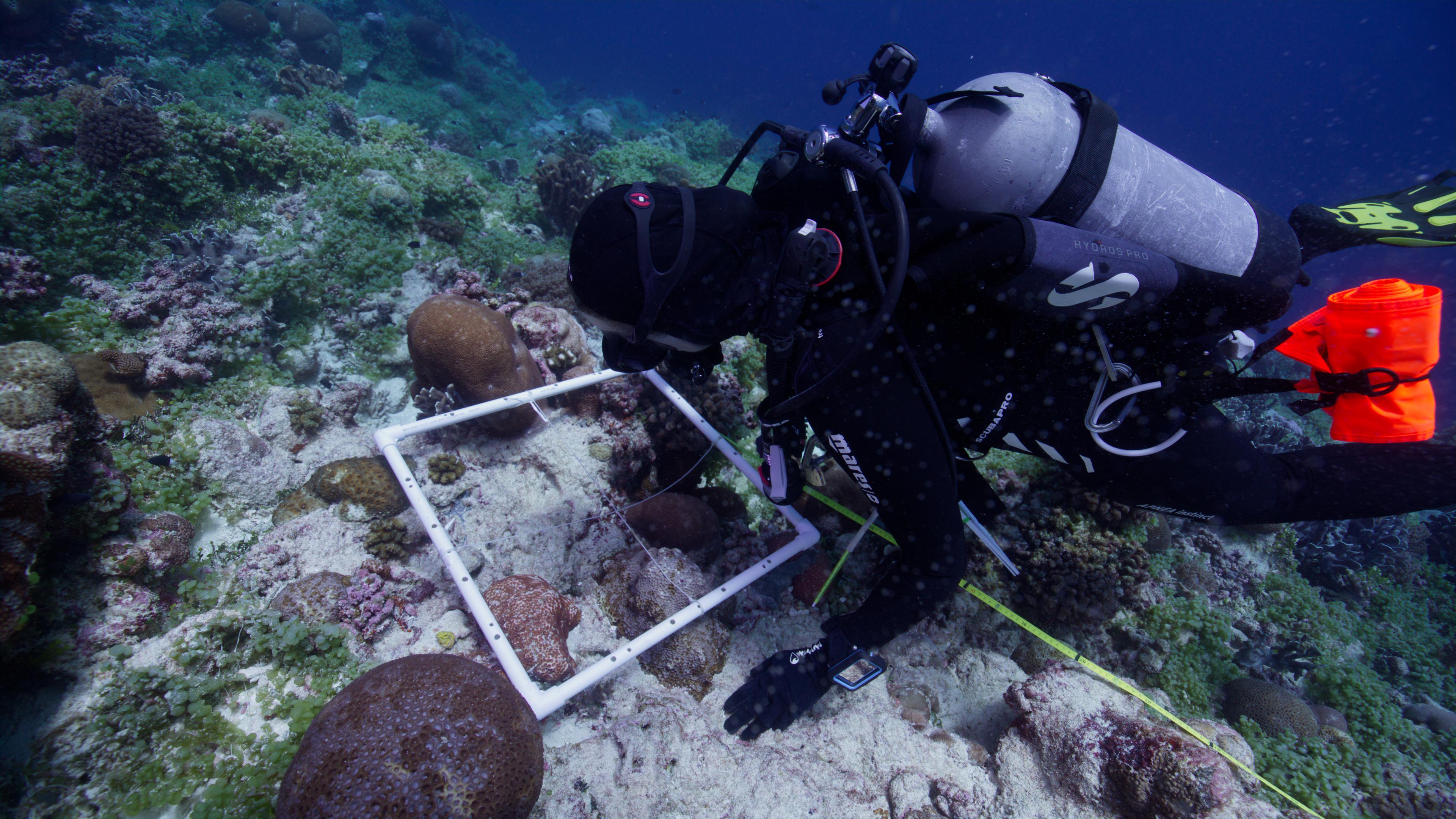
The coral recruit survey method employs a systematic quadrat-based approach to document the abundance, taxonomic identity, and size structure of juvenile coral colonies. This method has been refined through years of field experience to balance thoroughness with field efficiency, providing quantitative data suitable for assessing reef recovery potential.
Key Features
- Standardized quadrats: Fixed-area sampling units (50 × 50 cm)
- Systematic placement: Regular intervals along established transects
- Size-based approach: Focus on colonies ≤5 cm maximum diameter
- Taxonomic resolution: Identification to genus or species level when possible
- Photographic documentation: Each quadrat is photographed before examination
- Integration: Same transect line used for LPI and invertebrate surveys
- Substrate assessment: Documentation of settlement substrate types
- Condition evaluation: Notes on coral health, partial mortality, and bleaching
Field Implementation
Team Structure
The coral recruit survey is conducted by t specialized diver as part of the three-person benthic survey team. The recruit/invertebrate specialist completes the coral recruit survey first, followed by the invertebrate survey along the same transect, optimizing dive time while maintaining thorough coverage.
- Quadrat dimensions: 50 × 50 cm (0.25 m²)
- Quadrat placement: Every 5 m along the transect (10 quadrats total)
- Placement positions: 0, 5, 10, 15, 20, 25, 30, 35, 40, and 45 m marks
- Total survey area: 2.5 m² per transect
- Depth strata: Typically 10 m and 20 m (matching other benthic methods)
- Target size range: Corals ≤5 cm maximum diameter
- Timing: Conducted before invertebrate surveys
Collection Procedure
- Deployment coordination:
- The recruit survey utilizes the same 50 m transect line deployed for the LPI survey
- Begin at the 45 m mark and proceed along the transect towards the start.
- Quadrat placement:
- Place the quadrat on the substrate at each 5 m interval along the transect (0, 5, 10, …, 40, and 45 m marks)
- Ensure the quadrat is properly positioned without disturbing small corals
- The combined survey area across all quadrats is 2.5 m² per transect
- Quadrat documentation:
- Before searching for recruits, photograph each quadrat from above
- Include the quadrat ID tag in the image for reference
- These images serve as verification and provide context for identified recruits
- Quadrat examination:
- Systematically search the entire quadrat area in a consistent pattern
- Focus on colonies ≤5 cm maximum diameter with distinct tissue and skeletal boundaries
- Use the edge of dive slate marked in cm to measure sizes
- Exclude fragments or remnants of larger colonies
- Data recording:
- For each juvenile coral within the quadrat:
- Identify to lowest possible taxonomic level (genus or species)
- Measure maximum diameter to the nearest 0.5 mm (for colonies larger than 0.5 cm)
- Note the quadrat number to link records back to the quadrat image
- Document attachment substrate type
- Note any partial mortality, bleaching, or disease
- Record quadrat-level information:
- Dominant substrate type
- Approximate sediment cover (%)
- For each juvenile coral within the quadrat:
- Detailed documentation:
- Photograph unidentified or unusual recruits for later verification
- Take reference images of representative recruits
- Capture close-up images of taxonomically challenging specimens
- Survey completion:
- After examining all 10 quadrats, stow equipment securely
- Transition to invertebrate surveys (working back along the same transect)
- Note any unusual observations or methodological deviations
Taxonomic Framework
Accurate identification of juvenile corals presents unique challenges due to their small size and undeveloped morphological features. Pristine Seas employs a comprehensive taxonomic system that balances field practicality with scientific rigor, with the World Register of Marine Species (WoRMS) AphiaID serving as the authoritative identifier throughout all datasets.
Identification Process
Our taxonomic approach adapts to the inherent challenges of identifying juvenile corals in the field. The most significant difficulty stems from the dramatic morphological differences between juvenile and adult coral colonies:
- Undeveloped morphology: Young colonies lack the characteristic growth forms that define adult corals
- Limited polyp development: Colonies often have only a few polyps, obscuring diagnostic features
- Cryptic placement: Recruits frequently settle in concealed locations, complicating thorough examination
- Developmental plasticity: Early growth forms may differ substantially from adult morphology
To address these challenges, we implement a size-based hierarchical approach that matches identification precision to observable features:
We implement a hierarchical approach that matches identification precision to colony size and observable features:
For colonies smaller than 1 cm: Focus on basic skeletal structures and polyp arrangements, typically achieving family-level identification and sometimes genus-level when distinctive features are present.
For colonies between 1-3 cm: Incorporate tissue characteristics and emerging morphology, reliably achieving genus-level identification in most cases. Color patterns, polyp arrangement, and initial branching patterns become more distinctive.
For colonies between 3-5 cm: Apply standard adult coral identification criteria where applicable, enabling genus-level identification in nearly all cases and species-level identification when key diagnostic features are present.
Throughout this process, photographic documentation supports field identifications, allowing for post-dive verification and consultation with coral taxonomy specialists when necessary. This systematic approach acknowledges the practical limitations of field identification while maximizing taxonomic precision at each developmental stage.
Data Workflow
Data Entry
Coral recruit data are recorded in standardized Excel fieldbooks on the same day of data collection, while information and memory are fresh. The ISO3_YEAR_recruits_fieldbook.xlsx is organized as follows:
readmesheet: Contains expedition info, data entry instructions, and guidelinesstationssheet: Records station information including sampling depths, habitat types, and any deviations from protocolrecruitssheet: Primary data entry for all coral recruits, including , size measurements and substrate type, and quadrat level info
The recruits sheet includes validation rules that flag potential errors such as:
- Size measurements exceeding the 5 cm maximum threshold
- Missing taxonomic information
- Invalid quadrat numbers
The systematic organization of quadrat images is essential for later reference and quality control:
- Naming convention:
[ISO3]_[YEAR]_recruits_[SITE_ID]_[DEPTH]_Q[##].jpg - Example:
PLW_2023_recruits_005_10m_Q03.jpg(Palau, 2023, site 5, 10m depth, quadrat 3) - Storage structure: Images stored in folders mirroring site → station hierarchy
- Backup protocol: Daily transfer to expedition NAS and cloud backup when possible
Processing Pipeline
Our data processing transforms raw field observations into analysis-ready datasets through:
1. File Consolidation
First, we compile data from all divers and expedition legs into a unified dataset:
- Merge all recruits records from multiple dives and sites
- Standardize taxonomic names using our coral taxonomy reference table
- Add metadata from the UVS Sites Fieldbook (coordinates, habitat type, etc.)
- Validate image references and ensure all quadrats are properly documented
- Create a complete dataset that preserves all original observations
2. Quality Control
Next, we verify data quality through a systematic review process:
- Analyze size distributions to identify unlikely measurements
- Compare taxonomic identifications between observers for consistency
- Cross-check recruit taxa against adult corals identified in LPI surveys
- Verify substrate categorizations for consistency
- Ensure complete sampling coverage (all 10 quadrats per transect)
Potential issues are flagged for expert review rather than automatically removed, preserving data integrity while ensuring scientific accuracy.
3. Density Calculation
We then calculate standardized density metrics for cross-site comparisons:
- Compute recruit density (colonies/m²) by taxa and size class
- Account for the actual area sampled when fewer than 10 quadrats were completed
- Generate density metrics at multiple taxonomic levels (species, genus, family)
- Calculate size-based metrics (mean diameter, size class frequencies)
A critical step in this process is the addition of zero values for taxa that were not observed in a particular quadrat but were found elsewhere at the site. This ensures that absence data is properly incorporated when calculating average densities and prevents biased estimates. Zero values are applied:
- After taxonomic standardization but before aggregation
- Based on the observed taxa pool within each site
- Only for taxa recorded in at least one quadrat at the site
- Prior to calculating transect-level and station-level metrics
4. Database Integration
Finally, we format the processed data for ingestion into our central database, creating four core output files:
- recruits_observations: Individual coral records with standardized taxonomy and measurements
- recruits_density_by_taxa: Density calculations by taxa, size class, and station
- recruits_station_summary: Aggregate metrics by station (total density, diversity indices)
- recruits_taxa_summary: Region-wide patterns of occurrence and average densities
These standardized outputs allow consistent analysis across expeditions and regions while maintaining connections to the original field observations.
Exploratory Data Analysis
Our analytical approach examines coral recruitment through multiple complementary perspectives:
Recruitment Patterns
We analyze recruitment density and taxonomic composition across sites and regions:
- Total recruit density comparisons across habitat types and other gradients
- Taxonomic composition analysis to identify dominant recruiting taxa
- Comparison with regional and global benchmarks
- Correlation with adult coral cover and community structure from LPI surveys
These analyses provide insights into the factors controlling recruitment success and how it relates to broader ecological patterns.
Size Structure Assessment
Size distributions provide insights into recruitment timing and post-settlement survival:
- Size frequency analysis by taxa and life history strategy
- Cohort identification to detect recruitment pulses
- Comparison of size structures across environmental gradients
- Integration with known disturbance history
Size structure analysis is particularly valuable for identifying recruitment timing and evaluating post-settlement survival patterns.
Substrate Relationships
We examine how settlement substrate influences recruitment success:
- Quantification of substrate preferences by coral taxa
- Relationship between substrate availability and recruitment density
- Identification of recruitment microhabitats
- Role of crustose coralline algae (CCA) in facilitating settlement
These patterns reveal important information about habitat requirements for successful coral recruitment.
Spatial Patterns
By analyzing recruitment patterns across space, we identify:
- Recruitment hotspots and priority conservation areas
- Environmental correlates of recruitment success
- Depth-related patterns in recruit abundance and composition
- Connectivity implications for population replenishment
Cross-Method Integration
We combine recruit data with other survey components to reveal ecosystem relationships:
- Correlations between coral cover and recruit density
- Relationships between herbivorous fish and recruitment success
- Connections between benthic composition and recruit diversity
- Potential feedback loops linking predators, grazers, and coral recruitment
These integrated analyses provide a holistic understanding of reef ecosystem function and reveal the ecological processes that drive reef recovery and resilience.
Through these complementary analytical approaches, we transform field observations into ecological insights that inform conservation planning and contribute to our understanding of marine ecosystems—from individual reefs to global patterns.
Limitations
While quadrat surveys are an effective method for assessing coral recruitment, several limitations should be considered:
- Detection challenges: The smallest recruits (<5 mm) are extremely difficult to detect in field conditions, potentially leading to underestimates of recent recruitment
- Taxonomic uncertainty: Accurate species-level identification of recruits is challenging and often not possible for the smallest size classes
- Spatial heterogeneity: Recruitment can be highly patchy, requiring sufficient sample sizes to characterize site-level patterns
- Temporal variability: Recruitment is often episodic, with significant seasonal and annual variations that may not be captured in single surveys
- Post-settlement mortality: High mortality rates in the first weeks after settlement mean that visible recruits represent only a small fraction of initial settlers
- Microhabitat bias: Recruits in cryptic microhabitats (e.g., crevices, undersides) may be undersampled
We address these limitations through standardized protocols, thorough diver training, adequate replication, and integration with complementary methods like adult coral surveys and eDNA.
References
Darling ES, Alvarez-Filip L, Oliver TA, McClanahan TR, Côté IM (2012) Evaluating life-history strategies of reef corals from species traits. Ecology Letters 15(12): 1378-1386. https://doi.org/10.1111/j.1461-0248.2012.01861.x
Edmunds PJ, Leichter JJ, Johnston EC, Tong EJ, Toonen RJ (2016) Ecological and genetic variation in reef-building corals on four Society Islands. Limnology and Oceanography 61(2): 543-557. https://doi.org/10.1002/lno.10231
Ritson-Williams R, Arnold SN, Fogarty ND, Steneck RS, Vermeij MJ, Paul VJ (2009) New perspectives on ecological mechanisms affecting coral recruitment on reefs. Smithsonian Contributions to the Marine Sciences 38: 437-457.
Sommer B, Harrison PL, Beger M, Pandolfi JM (2014) Trait-mediated environmental filtering drives assembly at biogeographic transition zones. Ecology 95(4): 1000-1009. https://doi.org/10.1890/13-1445.1